Emmanuel Onwuegbusi
AI Automation Workflows for Venture Capital
Real automations I've built to solve problems VCs actually have, starting with an agent that reads inbound pitch decks, triages them against an investment thesis, and makes sure no founder gets left hanging.
← Back to full portfolioWhat's here
Everything below is a real, working automation, not a mockup. I built and tested each one end to end against real triggers and real integrations, and I'm showing you exactly what it produced: a screenshot, a short walkthrough, and the workflow itself as a file you can download and inspect.
Workflows
Deck Triage Agent
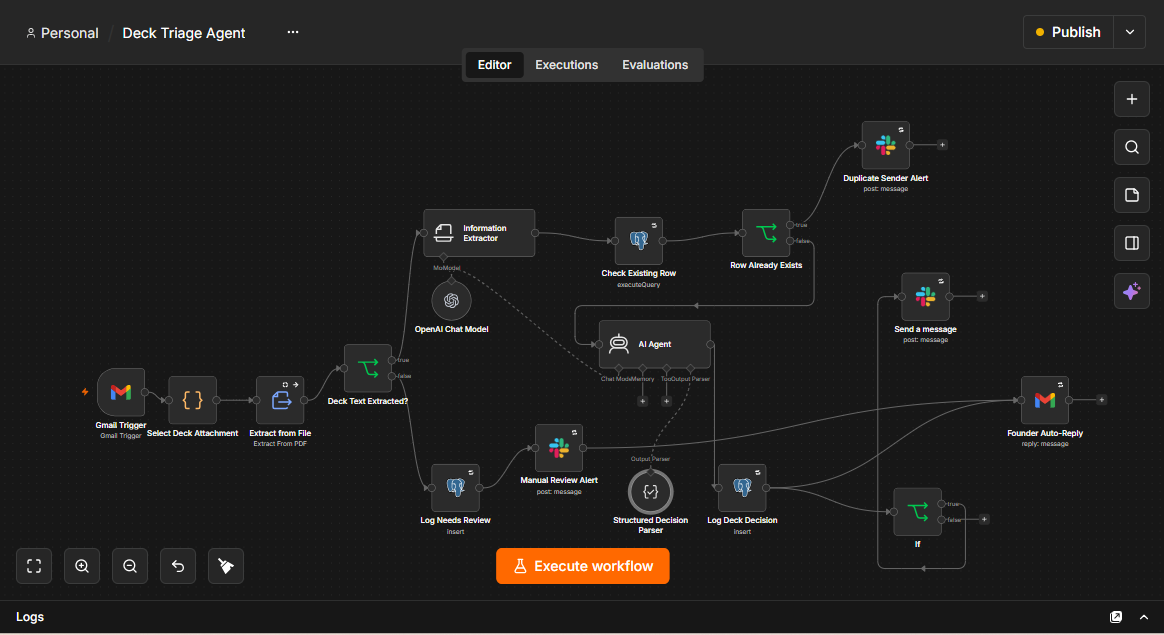
VCs lose good deals the same boring way every time: decks pile up in an inbox and either sit unread or get skimmed inconsistently between partners. This agent watches the deals inbox, pulls the full text out of every incoming deck (it correctly picks the actual deck out of an email even when it isn't the first attachment), and scores it FIT, MAYBE, or REJECT against a real investment thesis: stage, check size, target sectors, hard disqualifiers, and whether there's an actual traction or team signal.
Every decision gets logged with the full reasoning behind it, posted to Slack for the team (REJECTs stay quiet, so nobody's pinged over the obvious no's), and every founder gets an honest, non-committal reply, so nobody who emails in ever just hears nothing back. It's also built not to make things up: the model only reasons from the deck text it's actually given, anything too short or corrupted gets routed to a person instead of guessed at, and there's a guard against a deck trying to talk the model into approving itself.
Stack: n8n, Gmail API, OpenAI (GPT-4o-mini), PostgreSQL, Slack API, LangChain structured output parsing.
Demonstrated against SaanVC, a fictitious early-stage fund with an invented investment thesis, not a real client engagement.
Portfolio Monitoring Agent
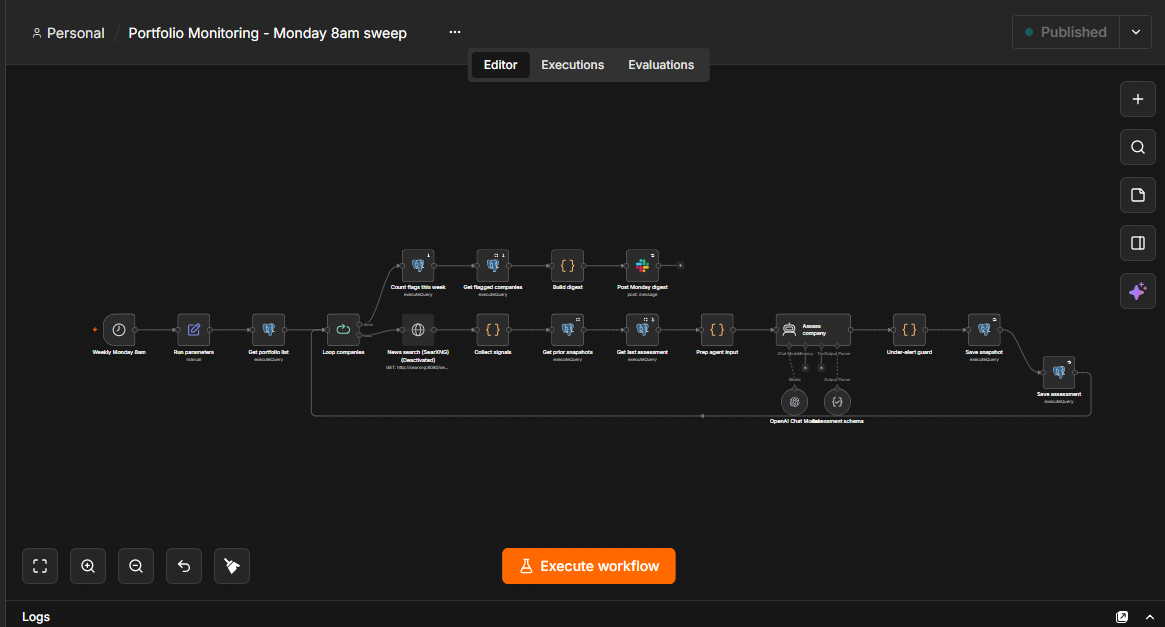
Between board meetings, partners lose the thread on how portfolio companies are actually doing. The warning signs are rarely one big event; they're small things that pile up unnoticed: a hiring freeze, a pricing page quietly pulled, three weeks of headcount slipping. This agent runs itself every Monday morning, walks the whole portfolio one company at a time, and compares this week against the weeks before it, from a history it keeps in its own database.
For each company it gathers public signals: news mentions over the last seven days, whether the website changed, hiring activity. Then it asks the model one question, not "what's the data" but "what changed, and do several small moves point the same direction?" It returns a status (healthy, watch, or urgent), a change score, and, the part that matters, the specific list of movements it's reacting to, so a partner can see the three weak signals for themselves instead of trusting a black-box "urgent."
The output is one Monday digest in Slack: "2 of 6 need attention", a short block per flagged company, and a concrete next step. Healthy companies stay silent. If everything's fine it still posts a one-line all-clear, so a quiet week never looks like a broken workflow.
It's deliberately tuned to under-alert, because a monitor that cries wolf gets muted. A single ambiguous signal is a "watch" at most; "urgent" needs multiple signals telling the same story. A deterministic guard sits after the model and can only make its verdict calmer, never louder, so it can't escalate on one data point. Soft signals get phrased softly ("careers page suggests hiring may have slowed", not "hiring has stopped"), every raw number it saw is stored so the judgment always shows its inputs, and the first time it sees a company it just records a baseline instead of inventing a trend.
Stack: n8n, Schedule Trigger, PostgreSQL (weekly snapshot history), OpenAI (GPT-4o-mini), SearXNG, Slack API, LangChain structured output parsing.
Demonstrated against Meridian, a fictitious early-stage fund with an invented portfolio, not a real client engagement.
Work with us
I help VCs design and build AI automations and agents like these, and offer AI consultancy for funds who want something like this built around their own portfolio, thesis, and tools.